What Does ㅋㅋ Mean in Korean?
ㅋㅋ is how Koreans type laughter — roughly 'haha' or 'lol'. What it means, why one ㅋ can sound cold, the ㅎㅎ cousins, and why you write it 'kk' and not 'kkk' in English.
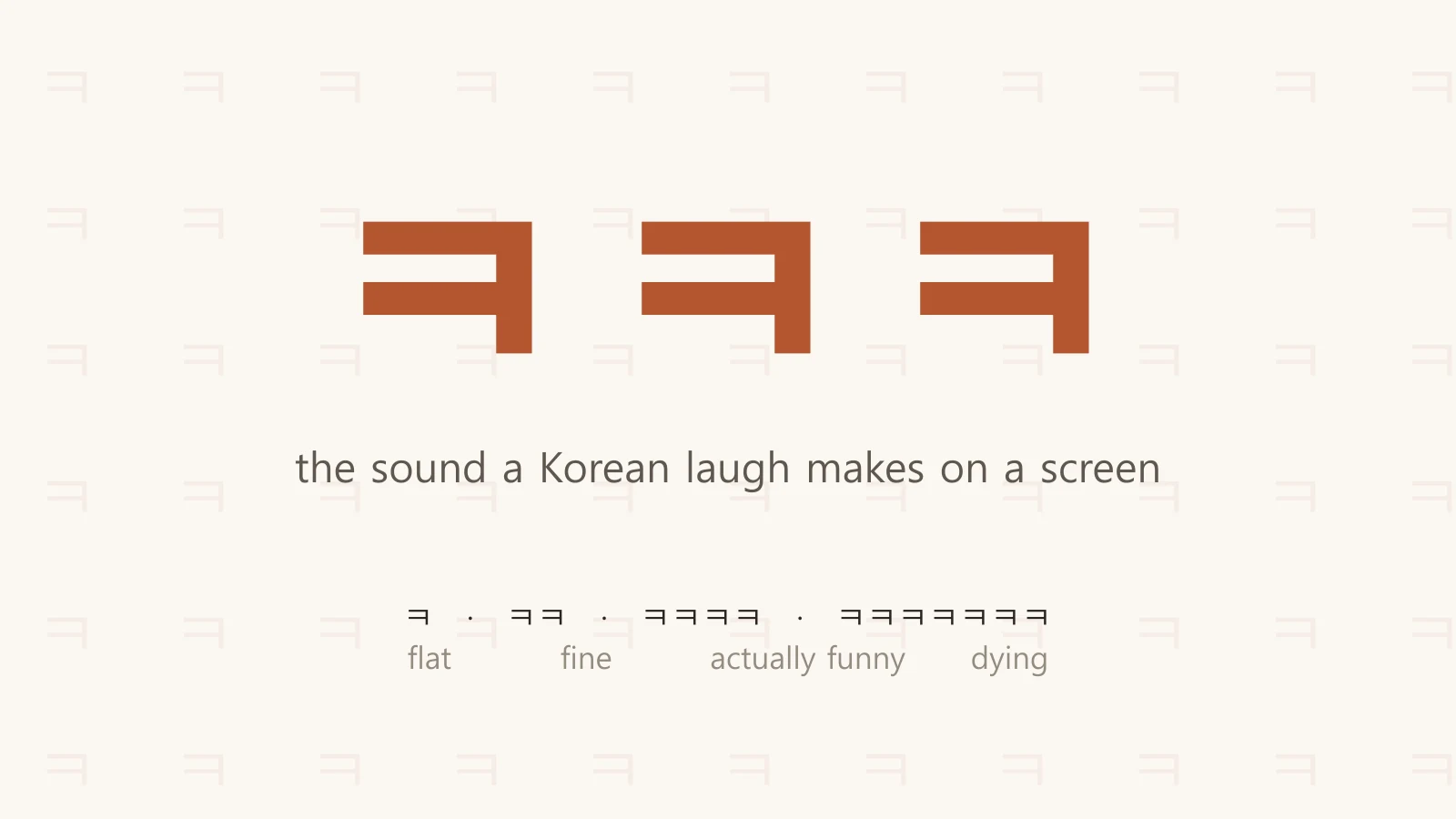
Text a Korean friend something funny and you’ll get a wall of ㅋ back. No words, just ㅋㅋㅋㅋㅋㅋ — the sound of laughter, written with a single consonant and repeated as far as the feeling goes.
It’s the most common thing in Korean chat, and also one of the easiest to get slightly wrong. The letter is simple. The number of them is a whole tone of voice.
haha / lol — laughter in text
Literally the consonant ㅋ (a hard 'k'), repeated
아 진짜 웃기다 ㅋㅋㅋ— ah, that's actually funny lol
⚠ Fine with friends and peers. Keep it out of formal emails, messages to a boss, or anything work-facing.
Why a lone consonant?
Korean normally stacks a consonant and a vowel into one syllable block — 카, 크, 코. But ㅋ on its own has no vowel to sit with, so your brain just reads the raw sound: a short, breathy, back-of-the-throat k. String it together and it’s the texture of a giggle. Koreans do the exact same trick with ㅎ (from 하하, “haha”) and, less often, ㅍ (from 풉, a snort).
The number of ㅋ is the tone
This is the part learners miss. One ㅋ and seven ㅋ are not “the same word, louder” — they land completely differently.
One ㅋ is a trap
If a friend sends you bad news and you reply with a single ㅋ, it reads as “heh. sucks for you.” Learners do this constantly — they mean a warm “haha” and send something that looks cold and dismissive.
I totally bombed my presentation today
If you do want to laugh with someone, give it at least ㅋㅋ, and match their energy — if they sent four, send four back.
The ㅎㅎ family and other cousins
ㅋ isn’t the only laugh in the drawer. Where it sits on the warm–dry line matters:
You’ll also meet playful misspellings that are meant to look unhinged: ㅋㅋㅋ루ㅋㅋㅋ (a stray 루 dropped in mid-laugh), ㅋㅋ큐ㅋㅋ, ㅋ ㅋ ㅋ with spaces (can read as slow, pointed, “why are you like this” laughter). And ㅠㅠ / ㅜㅜ are the crying eyes you saw above — not laughter, but they travel in the same texting toolkit.
Typing it in English: “kk”, not “kkk”
People search for this as “kkk” because that’s three ㅋ. But if you’re writing in the Latin alphabet — say, explaining it to a friend — write it kk or kekeke. In English, kkk reads as something else entirely, and you don’t want that in your group chat. Koreans sidestep the whole problem by just typing the actual Hangul: ㅋㅋ.
When to keep it out
ㅋㅋ is text-only and firmly casual. In speech you’d simply laugh. In writing, keep it away from:
- cover letters and job applications
- messages to a professor, a boss, or a client
- customer-service chats and formal email
With friends, peers, and most group chats, it’s everywhere — leaving it off can even make a message read as stiff or annoyed.
Cheat sheet
- ㅋ — flat / sarcastic. Rarely what you mean.
- ㅋㅋ — safe “haha”. Your default.
- ㅋㅋㅋㅋ+ — genuinely funny; match the sender’s length.
- ㅎㅎ — warmer, softer; good upward to older people you’re close to.
- 크크 / 킥킥 — snicker, slightly mischievous.
- ㅠㅠ — crying (sad or overwhelmed-laughing), not a laugh by itself.
- In English text:
kk, neverkkk.
Related reading
Part two of this pair is Korean texting slang: the shortcuts after ㅋㅋ — ㅇㅋ, ㄱㄱ, ㅈㅅ and the rest. For spoken Korean, Essential Korean Phrases for Travelers; and the convenience-store food guide is peak “ㅋㅋ 이거 존맛” territory.
Sources
- Korean language — writing system and consonants — Wikipedia (accessed 2026-08-29)
- Hangul — consonant letters — Wikipedia (accessed 2026-08-29)
- ㅋㅋ — Wiktionary — Wiktionary (accessed 2026-08-29)