Korean Texting Slang: The Shortcuts After ㅋㅋ
Korean chat is full of bare consonants and clipped words — ㅇㅋ, ㄱㄱ, ㅈㅅ, ㄹㅇ, 인싸, 갑분싸, 꿀잼. What they decode to, how to read a message full of them, and the two that are actually rude.
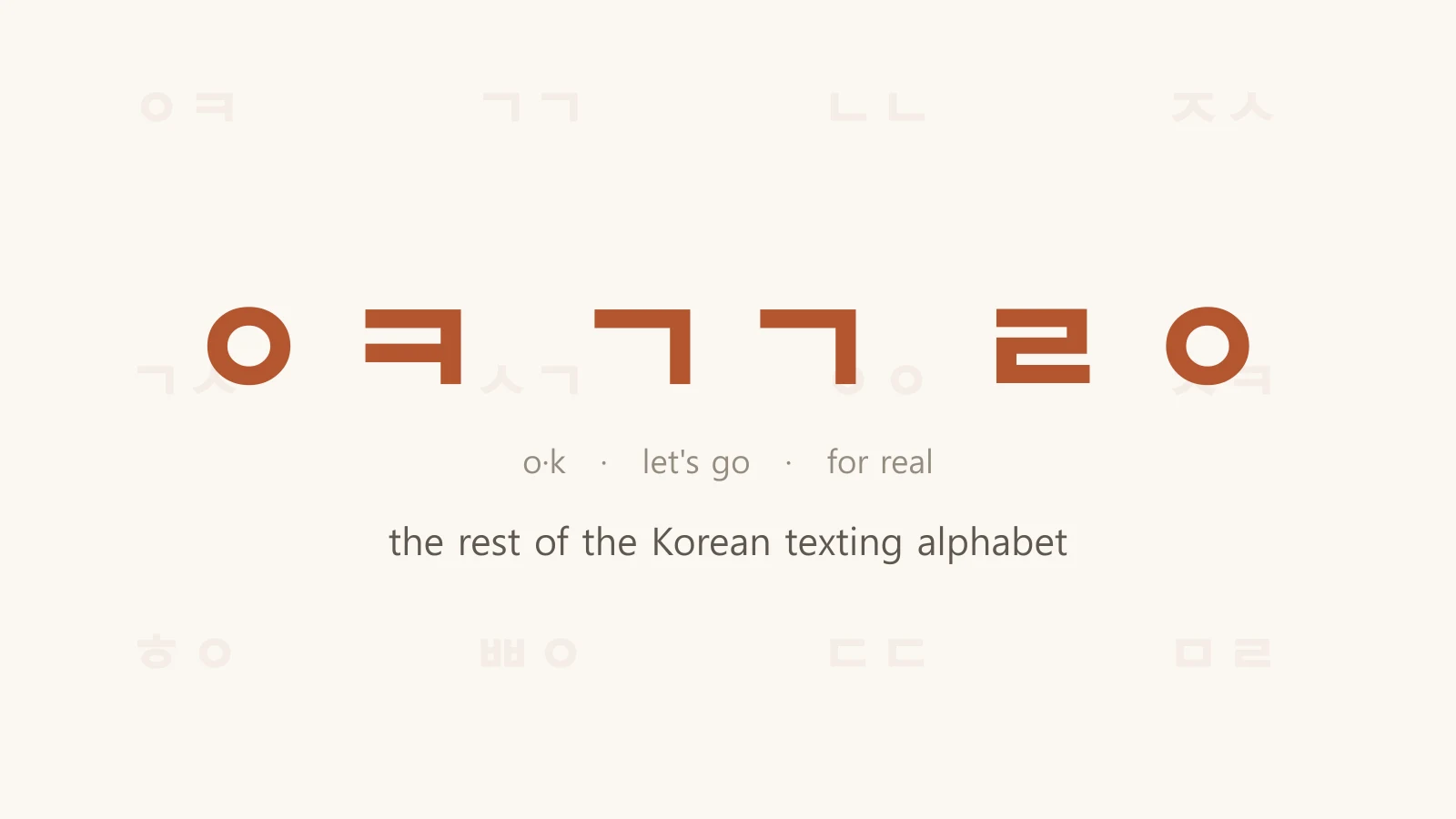
ㅋㅋ is the first Korean texting shorthand a learner meets, but it’s one of dozens. Korean chat strips words down to their bare consonants (ㅇㅋ for 오케이) or clips them to two syllables (갑분싸), and a message can be almost entirely made of it. Here’s enough to decode most of them.
None of this is formal. It’s for friends, group chats and comment sections — the same rule as ㅋㅋ. Two items near the end are genuinely rude; they’re flagged.
The consonant shortcuts
Take a short word, keep only the first letter of each syllable, drop the vowels. 오케이 → ㅇㅋ.
Reading a message made of them
hi — chicken & beer tonight, let’s go?
yeah — where?
dunno lol, anywhere
ok, 8pm, see ya
Clipped words and prefixes
- ㄹㅇ (real) — “for real / seriously.” Often stacked as ㄹㅇㅋㅋ.
- ㅇㅈ (인정) — “agreed / facts.” ㅇㅈ? ㅇㅈ. is a whole exchange.
- 꿀- / 핵- / 갓- — intensifiers. 꿀잼 = “super fun” (꿀 “honey” + 잼 “fun”); 노잼 = “not fun”; 핵꿀잼 = extremely fun; 갓띵작 = a god-tier masterpiece.
- 개- — a strong “really/very”: 개좋아 = “I really like it.” Casual, mildly coarse, extremely common.
- 안물안궁 — “didn’t ask, didn’t wonder” (안 물어봤고 안 궁금해). A dismissive reply.
- 1도 없다 / 1도 모름 — “not even a little.” The “1” is read as 하나.
Vibe words
| Term | Meaning |
|---|---|
| 인싸 / 아싸 | an “insider” (sociable, in the group) / an “outsider” |
| TMI | too much information — an overshare |
| 갑분싸 | “the mood suddenly went cold” — an awkward silence after something |
| 낄끼빠빠 | know when to jump in and when to back off (낄 때 끼고 빠질 때 빠져라) |
| 케바케 | “case by case” — it depends |
| 어그로 | attention-baiting, trolling (“aggro”) |
| 손절 | cutting someone off, writing them off |
| 오글거리다 | cringe; secondhand embarrassment |
Two that are actually rude
- ㅈㄴ (존나) — a vulgar intensifier, roughly “f***ing.” You’ll see it constantly online; do not use it with anyone you’re not close to, and never at work.
- ㅗ — a bare ㅗ is a stand-in for the middle finger. It’s not cute. Don’t send it, and read it as hostile if you receive one.
The short version
- Consonant shortcuts = first letter of each syllable: ㅇㅋ okay, ㄱㄱ let’s go, ㅈㅅ sorry, ㄱㅅ thanks, ㅅㄱ bye.
- ㄹㅇ = “for real”; ㅇㅈ = “agreed”; 꿀잼 / 노잼 = fun / not fun; 개- = “really.”
- 인싸 / 아싸, 갑분싸, 케바케 are the vibe words worth knowing.
- ㅈㄴ and ㅗ are rude — recognise them, don’t send them. All of this stays out of formal messages.
Related reading
Part one of this pair is what ㅋㅋ means in Korean. For the Korean you’d actually speak out loud, Essential Korean Phrases for Travelers; and if the bare consonants are still a puzzle, how to read Hangul in an hour.
Sources
- Korean language — writing system — Wikipedia (accessed 2026-08-30)
- ㅋㅋ — Wiktionary — Wiktionary (accessed 2026-08-30)