Essential Korean Phrases for Travelers
The Korean phrases that actually get used on a trip — greetings, ordering, shopping, transit, and getting help — with how to make almost anything polite using -요 and 주세요.
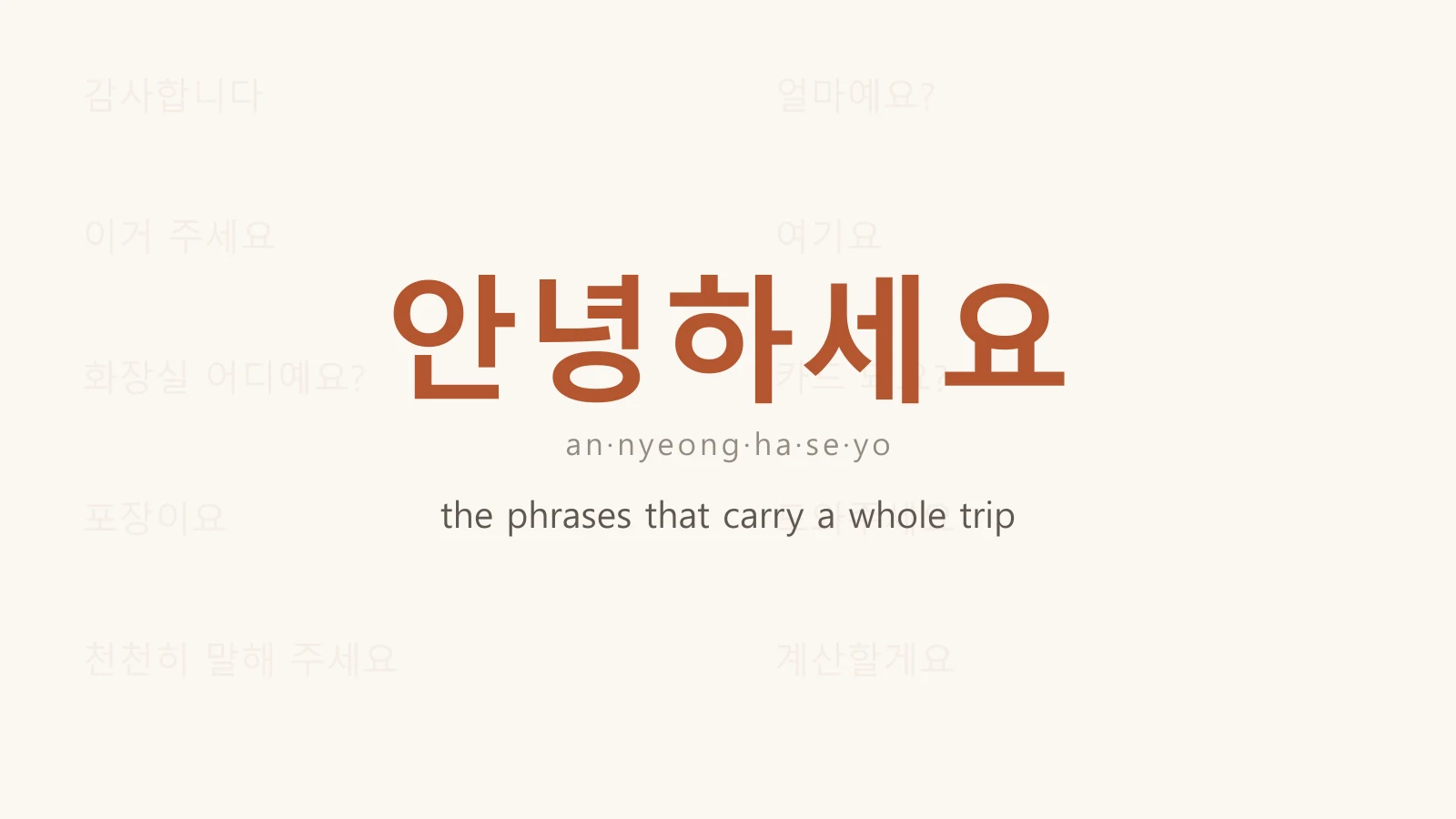
You can have a good trip in Korea with almost no Korean — signage and transit are bilingual, and translation apps do the heavy lifting. But a dozen phrases, said at the right moment, change how the trip feels: staff warm up, small problems get solved faster, and you stop feeling like you’re miming everything.
This is the working set. Romanization here follows the standard system; the vowels that trip people up are 어 ≈ “uh”, 으 ≈ the e in “the”, and 에/애 ≈ “eh”. Learning to read Hangul itself is the natural next step and takes about an hour — but you don’t need it for any of this.
First, the one rule: keep it polite
Korean changes shape depending on who you’re talking to. As a traveler you only need the polite everyday level — the one that ends in -요 or -세요. It’s respectful without being stiff, it works with everyone from a taxi driver to a hotel clerk, and nobody will ever be annoyed that you used it.
The other half of “polite” is a single, endlessly useful word: 주세요 (ju-se-yo), “please give me.” Bolt it onto almost any noun and you have a complete, courteous request.
The five that do the most work
If you learn only five, learn these.
Hello (any time of day)
안녕하세요, 두 명이요.— Hello, table for two.
Thank you
Literally also 고맙습니다 (go-map-seum-ni-da) — same meaning, slightly warmer
I'm sorry
Literally to get past someone or get attention, use 실례합니다 (sil-lye-ham-ni-da), 'excuse me'
How much is it?
이거 얼마예요?— How much is this?
This one, please
Literally works while pointing at anything — a dish, an item, a spot on a menu
Eating out
| Korean | Romanization | Meaning |
|---|---|---|
| 여기요 / 저기요 | yeo-gi-yo / jeo-gi-yo | Excuse me (to call staff over) |
| 메뉴판 주세요 | me-nyu-pan ju-se-yo | Menu, please |
| 이거 뭐예요? | i-geo mwo-ye-yo | What is this? |
| 안 매운 거 있어요? | an mae-un geo i-sseo-yo | Is there something not spicy? |
| 물 좀 주세요 | mul jom ju-se-yo | Some water, please |
| 포장이요 / 포장해 주세요 | po-jang-i-yo / po-jang-hae ju-se-yo | To go / takeout, please |
| 계산할게요 / 계산이요 | gye-san-hal-ge-yo / gye-san-i-yo | I’ll pay now / the check |
| 맛있어요! | ma-si-sseo-yo | It’s delicious! |
| 화장실 어디예요? | hwa-jang-sil eo-di-ye-yo | Where’s the bathroom? |
At the table there are also two set phrases worth saying — 잘 먹겠습니다 before you eat and 잘 먹었습니다 after. More on that in Korean table manners.
Shopping and paying
| Korean | Romanization | Meaning |
|---|---|---|
| 이거 있어요? | i-geo i-sseo-yo | Do you have this? |
| 얼마예요? | eol-ma-ye-yo | How much is it? |
| 카드 돼요? | ka-deu dwae-yo | Do you take card? |
| 봉투 주세요 | bong-tu ju-se-yo | A bag, please |
| 봉투 필요 없어요 | bong-tu pi-ryo eop-seo-yo | I don’t need a bag |
| 그냥 볼게요 | geu-nyang bol-ge-yo | I’m just looking |
| 좀 깎아 주세요 | jom kka-kka ju-se-yo | A little off the price, please (traditional markets only) |
Getting around
| Korean | Romanization | Meaning |
|---|---|---|
| ~ 어디예요? | ~ eo-di-ye-yo | Where is ~? (역 어디예요? = where’s the station?) |
| 여기 세워 주세요 | yeo-gi se-wo ju-se-yo | Stop here, please (in a taxi) |
| ~(으)로 가 주세요 | ~ (eu-)ro ga ju-se-yo | Please take me to ~ |
| 지하철역이 어디예요? | ji-ha-cheol-yeo-gi eo-di-ye-yo | Where’s the subway station? |
| 이 버스 ~ 가요? | i beo-seu ~ ga-yo | Does this bus go to ~? |
| 왼쪽 / 오른쪽 / 직진 | oen-jjok / o-reun-jjok / jik-jin | Left / right / straight ahead |
For a taxi, showing the destination on your phone in Korean is more reliable than saying it — pair it with 가 주세요.
When something goes wrong
| Korean | Romanization | Meaning |
|---|---|---|
| 한국어 잘 못해요 | han-gu-geo jal mot-hae-yo | I don’t speak Korean well |
| 영어 하세요? | yeong-eo ha-se-yo | Do you speak English? |
| 천천히 말해 주세요 | cheon-cheon-hi mal-hae ju-se-yo | Please speak slowly |
| 다시 한번 말해 주세요 | da-si han-beon mal-hae ju-se-yo | Please say that once more |
| 이해 못했어요 | i-hae mot-hae-sseo-yo | I didn’t understand |
| 도와주세요 | do-wa-ju-se-yo | Please help me |
| 아파요 | a-pa-yo | I’m hurt / I feel sick |
| 지갑을 잃어버렸어요 | ji-ga-beul i-reo-beo-ryeo-sseo-yo | I lost my wallet |
| 병원 / 경찰서 어디예요? | byeong-won / gyeong-chal-seo eo-di-ye-yo | Where’s the hospital / police station? |
Korea’s emergency numbers are 119 (fire, ambulance) and 112 (police); both have English support.
Small courtesies that punch above their weight
| Korean | Romanization | Meaning |
|---|---|---|
| 네 / 아니요 | ne / a-ni-yo | Yes / no |
| 잠깐만요 | jam-kkan-man-yo | Just a moment |
| 괜찮아요 | gwaen-cha-na-yo | It’s fine / I’m okay / no thanks (by context) |
| 아니에요 | a-ni-e-yo | It’s nothing (a reply to “thank you”) |
| 수고하세요 | su-go-ha-se-yo | “Thanks for your work” — nice on the way out of a shop or taxi |
The short version
- Stay on the -요 / -세요 level with everyone. You can’t overshoot politeness as a visitor.
- [noun] + 주세요 is a whole toolkit: 물 주세요, 계산서 주세요, 이거 주세요.
- 여기요 to call staff, 얼마예요? to ask a price, 화장실 어디예요? roughly hourly.
- If you’re stuck: 천천히 말해 주세요 or 영어 하세요?, and 도와주세요 for real trouble.
Related reading
For the casual register you’ll see in texts and comments (and should not use with a stranger), see what ㅋㅋ means in Korean. To use these at a meal without missteps, Korean table manners; to use them at a corner store, the convenience-store food guide.
Sources
- Korean language — Wikipedia (accessed 2026-08-29)
- Korean speech levels — Wikipedia (accessed 2026-08-29)
- Revised Romanization of Korean — Wikipedia (accessed 2026-08-29)