How to Read Hangul in an Hour
The Korean alphabet was built to be learned in a morning. Here are the consonants, the vowels, and the one rule for stacking them into syllable blocks — enough to sound out signs, menus and station names.
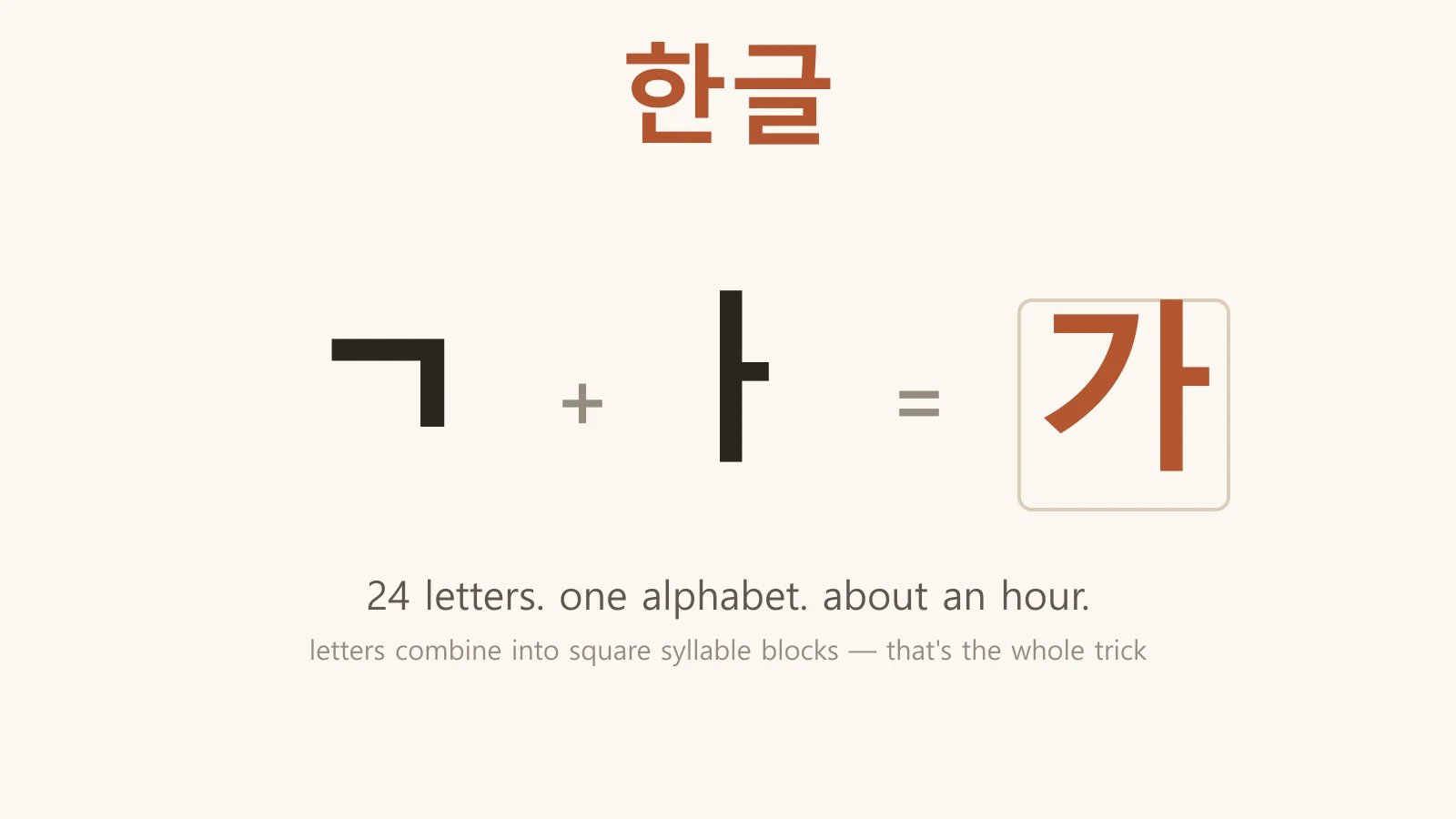
Korean writing looks like a wall of little symbols, so most visitors assume it’s memorisation on the scale of Chinese characters. It isn’t. Hangul is an alphabet — 24 basic letters, invented in the 1440s specifically so that anyone could learn it quickly. An hour of focused attention and you can sound out signs, station names and half a menu. You won’t understand the words, but you’ll stop being illiterate, and that changes a trip.
The one trick: letters stack into blocks
Every Korean syllable is written as one square block of two to four letters. You read a block from top-left, then across, then down, and every block starts with a consonant.
One special letter: ㅇ. At the start of a block it’s silent — a placeholder so the block has its required opening consonant. At the bottom of a block it’s “-ng”. So 아 is just “a”, and 앙 is “ang”.
The consonants
Fourteen basic ones. Five were drawn to look like the mouth making the sound (shown in colour); the rest are those five plus extra strokes.
The g/k, d/t, b/p pairs aren’t two choices — the sound just softens between vowels. 부산 is “Busan”, not “Pusan”; 대구 is “Daegu”. Don’t overthink it.
The vowels
Ten basic ones, built from three pieces: a vertical line ㅣ, a horizontal line ㅡ, and a short stroke. Add a second stroke and you add a “y-”: ㅏ (a) → ㅑ (ya), ㅗ (o) → ㅛ (yo).
Now read these
Take them one block at a time, left letter first.
| Word | Blocks | Sounds out as |
|---|---|---|
| 안녕 | 안 = ㅇ·ㅏ·ㄴ · 녕 = ㄴ·ㅕ·ㅇ | an + nyeong → “annyeong” (hi) |
| 김치 | 김 = ㄱ·ㅣ·ㅁ · 치 = ㅊ·ㅣ | gim + chi → “kimchi” |
| 서울 | 서 = ㅅ·ㅓ · 울 = ㅇ·ㅜ·ㄹ | seo + ul → “Seoul” |
| 소주 | 소 = ㅅ·ㅗ · 주 = ㅈ·ㅜ | so + ju → “soju” |
| 비빔밥 | 비 = ㅂ·ㅣ · 빔 = ㅂ·ㅣ·ㅁ · 밥 = ㅂ·ㅏ·ㅂ | bi + bim + bap → “bibimbap” |
| 화장실 | 화 = ㅎ·ㅘ · 장 = ㅈ·ㅏ·ㅇ · 실 = ㅅ·ㅣ·ㄹ | hwa + jang + sil → “bathroom” |
| 지하철 | 지 = ㅈ·ㅣ · 하 = ㅎ·ㅏ · 철 = ㅊ·ㅓ·ㄹ | ji + ha + cheol → “subway” |
What you can skip for now
Real pronunciation has a few sound-change rules — a final ㄱ/ㄷ/ㅂ gets clipped, ㄹ and ㄴ swap in places, a final consonant slides onto the next block’s vowel. You don’t need any of that to decode. Sound a word out letter by letter and a Korean will understand you; the rules just make it smoother. Pick them up later, or don’t.
The short version
- 24 letters; every syllable is one square block; read top-left, across, then down.
- Blocks always open with a consonant. ㅇ at the front is silent, at the bottom it’s “-ng”.
- Vertical vowels (ㅏ ㅓ ㅣ) sit to the right of the first consonant; horizontal vowels (ㅗ ㅜ ㅡ) sit below it.
- Watch ㅓ = “uh” and ㅡ = “eu”; treat g/k, d/t, b/p as one softish sound each.
- Spend the hour, then go read the tables in Essential Korean Phrases — they’ll suddenly make sense.
Related reading
Once the letters click, Essential Korean Phrases for Travelers is the next stop, and what ㅋㅋ means in Korean is a short, fun read about using single letters as whole words. You’ll also find you can now decode half the convenience-store food guide.
Sources
- Hangul — Wikipedia (accessed 2026-08-29)
- Korean language — Wikipedia (accessed 2026-08-29)
- Revised Romanization of Korean — Wikipedia (accessed 2026-08-29)