The Two Korean Number Systems (and When to Use Each)
Korean has two full sets of numbers — native Korean and Sino-Korean — and which one you use depends on what you're counting. The rule, the time trap, and the counters that go with them.
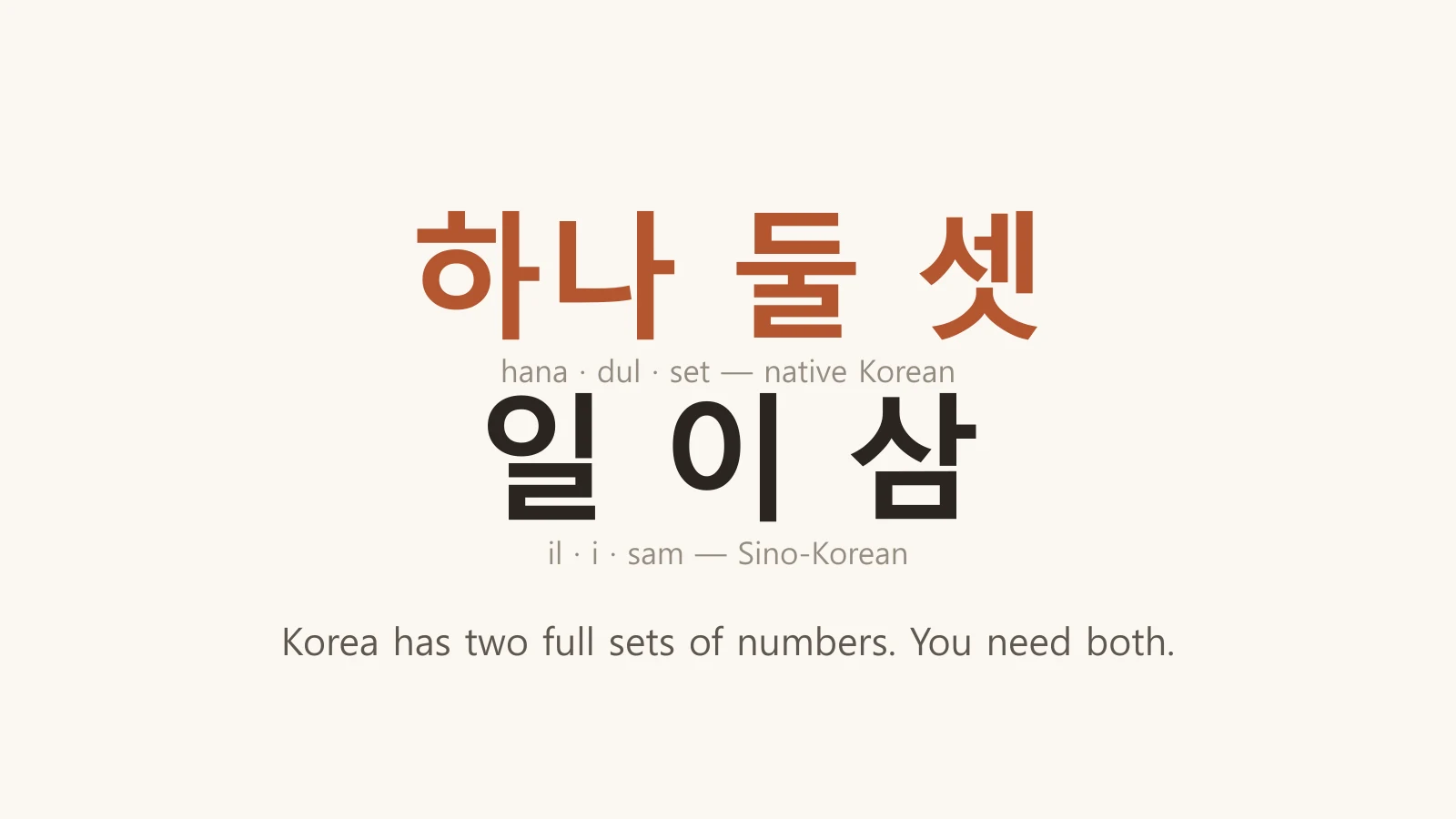
Korean runs on two complete sets of numbers. One is native Korean (하나, 둘, 셋…); the other, Sino-Korean, came from Chinese centuries ago (일, 이, 삼…). Both are in daily use, and which one a Korean reaches for depends entirely on what is being counted. Get the pairing wrong and you’ll be understood, but it sounds off — like saying “the second of clock.”
The two sets, one to ten
Which set for what
So ₩3,500 is samcheon-obaek won (Sino), but two coffees is keopi du jan — 커피 두 잔 (native + a counter).
The trap: telling the time
Time splits the two systems down the middle. The hour is native. The minutes are Sino.
Counters
Native numbers rarely stand alone in front of a noun. You count with a counter — “coffee two cups”, “ticket three sheets”. The common ones:
| Counter | For | Example |
|---|---|---|
| 개 (gae) | general objects | 사과 한 개 — one apple |
| 명 (myeong) | people | 두 명이요 — two people (at a restaurant) |
| 잔 (jan) | cups, glasses | 커피 세 잔 — three coffees |
| 병 (byeong) | bottles | 맥주 두 병 — two beers |
| 마리 (mari) | animals | 고양이 한 마리 — one cat |
| 장 (jang) | flat sheets | 표 두 장 — two tickets |
| 번 (beon) | times / turn | 한 번 더 — one more time |
1, 2, 3, 4 and 20 change shape before a counter: 하나 → 한, 둘 → 두, 셋 → 세, 넷 → 네, 스물 → 스무. So it’s han gae, du myeong, se jan — not hana gae.
What a traveler actually needs
- Prices are almost always written down — you mostly read them. If you have to say one, reading the digits in Sino (i · sam · o · o · gong for 2,355) works, or just show the number.
- “This many, please” — hold up fingers, or say 한 개 / 두 개 / 세 개 (one / two / three + 개).
- Time — read a clock face; 세 시 is 3:00, 여섯 시 is 6:00.
- Everything else you can point at.
The short version
- Sino-Korean (일 이 삼): money, dates, phone numbers, minutes, line numbers, anything big.
- Native Korean (하나 둘 셋): counting objects (with a counter), the hour, casual age.
- Time mixes them: hour native, minutes Sino — 세 시 삼십 분.
- Before a counter, 하나/둘/셋/넷/스물 → 한/두/세/네/스무.
Related reading
Numbers slot straight into Essential Korean Phrases for Travelers — “얼마예요?” and “두 명이요” especially. If the Hangul is still slowing you down, how to read Hangul in an hour; and for the other counting system that trips people up, Korean age.
Sources
- Korean numerals — Wikipedia (accessed 2026-09-08)
- Korean language — Wikipedia (accessed 2026-09-08)
- Korean count word — Wikipedia (accessed 2026-09-08)