Korean Age: Why Everyone Got a Year Younger in 2023
For decades a Korean could be three ages at once. A 2023 law made international age the legal standard — but people still ask how old you are, and here's why that matters.
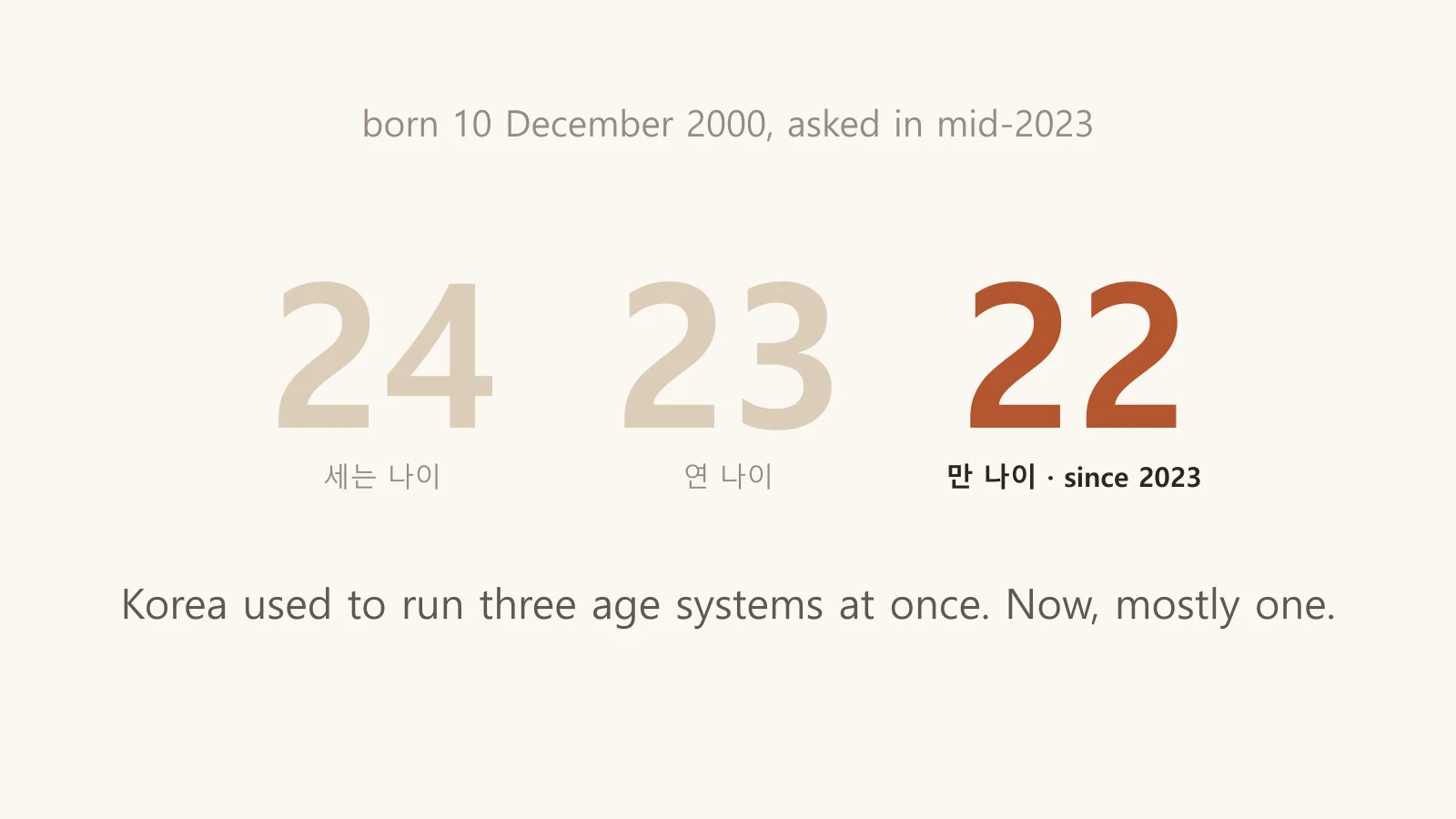
For most of the last century, a Korean could truthfully give three different answers to “how old are you?” — and which one they gave depended on whether they were filling in a medical form, checking if they could legally buy soju, or just talking to a stranger. A law that took effect on 28 June 2023 cleaned most of that up. Here’s what the systems were, what actually changed, and why the question still comes up.
The three ages
- 세는 나이 — the traditional “Korean age.” You’re 1 the day you’re born (the year in the womb counts), and everyone gains a year together on 1 January. A baby born on 31 December is “two” the next day.
- 연 나이 — “year age.” You start at 0, but you still tick up on 1 January, not your birthday. Used in a handful of specific laws.
- 만 나이 — international age. Start at 0, gain a year on your birthday. What the rest of the world uses, and now Korea’s legal default.
What the 2023 law did
The revision that took effect on 28 June 2023 made 만 나이 the standard for all judicial and administrative purposes — contracts, medical records, official documents, news reporting. Overnight, more than fifty million people were officially a year (or two) younger. If you’re a visitor, this is the simple part: your Korean age is now just your age. The number on your passport is the number that counts.
What still runs on the old clock
A few things kept 연 나이 on purpose, because they work better as whole-year cohorts:
- Military conscription timing.
- Buying alcohol and cigarettes — you’re eligible from 1 January of the year you turn 19, not from your birthday.
- School years — children start primary school by birth year.
And socially, habit lingers. Someone chatting with you may still think in 세는 나이, especially older people; you might hear “한국 나이로는…” (“in Korean age…”) as a bridge. It’s fading fast among younger Koreans since 2023, but it hasn’t vanished.
Why anyone asks in the first place
To an English speaker, “how old are you?” from someone you just met feels intrusive. In Korean it’s closer to a setup question. The answer determines:
- whether you speak to each other in 존댓말 (polite) or 반말 (casual),
- what you call each other — an older man is 형 / 오빠, an older woman 누나 / 언니,
- small defaults like who reaches for the bill first.
It’s the same seniority logic that runs through the dinner table. Being a year older or younger isn’t status exactly, but it does assign roles, and Korean can’t stay neutral about it the way English can — you have to pick a verb ending.
If someone asks you
Give your real (international) age. That’s now also your Korean legal age, so there’s nothing to convert. If they follow up with a birth year, that’s them working out the fine-grained seniority — you can just answer it. The old “빠른 년생” complication (people born in January–February being grouped with the previous year’s school cohort) was tied to the school-entry rules and is on its way out; you can ignore it.
The short version
- Old Korea ran three age counts at once: 세는 나이 (born at 1, +1 on 1 Jan), 연 나이 (born at 0, +1 on 1 Jan), 만 나이 (born at 0, +1 on your birthday).
- Since 28 June 2023, 만 나이 — international age — is the legal standard. Your age is just your age.
- Exceptions still on 연 나이: conscription, the drinking/smoking age, school cohorts.
- People still ask your age because Korean grammar and relationship terms depend on it. Answer with your real age.
Related reading
The seniority this feeds into shows up most clearly at a meal — see Korean table manners. For the polite verb endings themselves, Essential Korean Phrases for Travelers; and for another everyday custom that surprises visitors, why Koreans take off their shoes indoors.
Sources
- South Koreans become younger overnight after country scraps 'Korean age' — CNN (accessed 2026-08-30)
- Koreans Becoming Younger – Unification of Age-Counting Systems — Library of Congress (Law Library blog) (accessed 2026-08-30)
- East Asian age reckoning — Wikipedia (accessed 2026-08-30)